
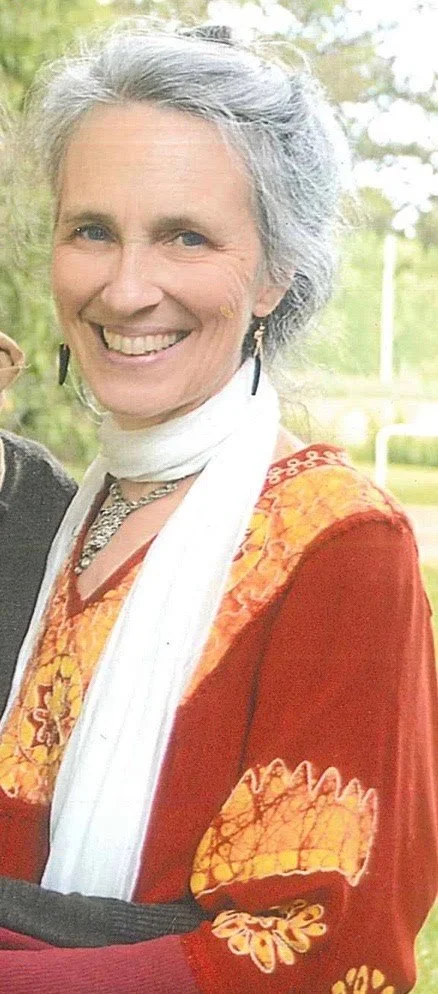
About Liz Rog

April 20, 2026
Liz Rog
One evening a few years ago here in my Iowa hometown I was driving some boys to a teen party. They told me that one of the girls at the party was having a birthday, and I got excited to teach them some fun new birthday songs to sing for her. We were happily rolling along and singing when suddenly I saw, tailing close behind us, a black car with a red and blue flashing light atop. What could I have done? I was driving so slowly! I pulled over. The policeman approached and asked, incredulous, why I had done a U-turn over the sidewalk! I winced, embarrassed, and told him that I hadn’t realized I’d done that, for I was focused on teaching birthday songs to this car-ful of boys…
And then it came back to me, the memory from when I was 16 years old and my parents wouldn’t let me get my driver’s licence because they thought I’d get lost in singing and forget where I was going.
Mind you, I’ve never had an accident, never hurt a living thing besides, sadly, a big buck who once jumped onto my windshield. But songs are with me always, if not outloud then humming, if not humming then just rolling in my mind. Songs are my way of feeling and knowing the world. Songs are my lovers, my deities, my prayers. Without them, I am alone. By them, I am connected to everything through all of time.
From where does the soul come? And how does it find its way in this life?
My dad, Frank, called himself ‘director of fun and games,’ and I wanted to be like him when I grew up. His actual job was as director of parks and recreation for the new suburb where we lived, and he was all about making ways for people to gather and enjoy one another's company, mostly outside in parks. He had grown up poor and now, living a middle-class life, he was generous with everything that he–and other people–had. Yes, he lived in the expectation that we would all share everything. (Not everyone agreed, including mom, but he didn’t hold it against her, or them.) Dad didn’t expect perfection in any realm, be it carpentry, orderliness, or manners. Good-enough was good-enough. I saw in him, and in the rest of my first generation Polish-American relatives, a laid-back and joyful way of being.
My mom is Janet, still alive at age 92. She has dementia now and conversations with her are simple, repetitive, and generally pleasant. She loves being around people. You might not be able to imagine, if you just met her recently, all of the intelligence and passion that she brought to her mothering and community life. But, oh, she did, she did! Mom brought beauty and order to our home, kept cultural traditions, engaged in grassroots social justice activism, built neighborhood and church life, and left radical books and periodicals lying around the house for us to bump into, like How the Other Half Lives, and Things that Make for Peace. She questioned modernity, always resisting the next technological advance that tv told us we were supposed to want. Dad was a happy sucker for that stuff: One day when he proudly walked in the door with a special gift for her, an early version of a microwave oven, she ran into the bedroom, locked the door, and wept, for she just did not want the fast nor the new.
Oh yeah, and she did all of the cooking and housework and schlepping of us kids.
I was born in 1961, too late to be part of the Age of Aquarius, but not too late to understand that many people just a bit older than I were questioning everything about American culture, politics, education, war, and economy. Questioning the very assumption that we were on a straight-line progression of improvement. Because of what I caught on tv and radio about the Civil Rights, Black Liberation, Women’s, and Environmental movements, I grew up believing that there were things we needed to do better, and we were the ones to do it. In high school I wore two buttons: the black and white one said ‘Question Authority,’ the red and white one said ‘You Are Loved.’
I had big visions for what I could do when I grew up! At some point I thought I wanted to be president (of the US, yes) and bring about world peace. Then I switched to the idea of being a healer, maybe getting my medical degree first and then adding alternative healing practices. I had other ambitious ideas of how to help the world, and then suddenly I was an adult and started taking jobs here and there: bakery cashier, waitress, overnight caretaker for elderly, page in the state capital, counselor at day camp for people with disabilities, restaurant dishwasher, art class model, back room sorter at second hand store, and again, waitress ($2/hr + ¢25-50 tips!)
The message given to us suburban kids growing up in the 60s and 70s was that we would go to college, come out with our important job, and do it for the rest of our adult lives. Ha! Seldom true! Yet I never once felt disappointed that I was doing what might be thought by some as surprisingly menial jobs for a dreamer such as me. I truly felt lucky to be out in the world meeting people, and amazed that I got money for it. I could feel the power of connection and the opportunities to bring kindness, and that was totally satisfying. In those years there were lots of posters and bumper stickers around with the saying Think globally, act locally; as a waitress I did feel kind of like the president of my own local scene, and would have done it forever if I hadn’t been fired for interacting with the customers too much.
By my mid-30s I was settled into being the co-manager of our smalltown food co-op, bringing to the job my daughter-of-a-recreation director/neighborhood builder belief that it was actually just all about helping people make connections. I was also a young mother, wife, cleaner and host for weekend guests at our cabin. A relentless organizer of community cultural events and camps. Later on, when Iowa got marriage equality, I became a wedding officiant.
All good, but there was always an ache, a calling that I didn’t know how to answer: I wanted to be singing all the time with other people. I tried being in folk bands, in formal choirs, around campfires, and all of that was great but it wasn’t IT.
Recently I came upon a copy of a letter I had written in 2004, when I was 43, to one of my heroines of music, Peggy Seeger (Pete’s half-sister), whose 1973 political album At the Present Moment had been one of my most powerful teen inspirations. I was a total stranger but in this 5-page letter that I sent in the postal mail I poured my heart out to her. Here’s a snippet:
…I am sad to tell you that, although I have always intended to devote my life to songs, I am still too far away from making that true. Anyone who knows me would tell you that I know thousands of songs and can bring one up for any occasion, so they would laugh to hear me say that I haven’t done what I meant to. But I tell you, I haven’t even begun. I want to learn a new song every week, and to spend the majority of my time singing with others, teaching simple songs of empowerment, and performing complex songs that inspire us to do what’s right. For me there would be no greater work than to do what you are doing.
What I am doing instead is all good stuff that I’ve chosen: managing our thriving food co-op that focuses on sustainable agriculture; working with children and families in an alternative education model that helps strengthen our community; raising two strong, independent daughters. We sing at our house, and occasionally our family sings for public events. But it’s not enough! I have to keep reminding myself of something I read in Natalie Goldberg’s autobiography, Long Quiet Highway. A woman goes to the monastery and says that she wants to become a monk, and the monk says to her, “go and raise three children – then you will be ready to study here”. For some obvious reasons, that story made me angry when I read it. Now it comforts me. I tell myself that my time is coming, and that I will be so ready by then that there’ll be no stopping me. I will be the singing granny, and they won’t dare not listen, for they’ll know that my wrinkles bespeak wisdom and the memory of a different time (not only the memory of the mid-late 20th century, but also an ancient memory of a Time of Songs). I am honing in on all of that. Meanwhile, I just keep on going one song at a time, in-between everything else….
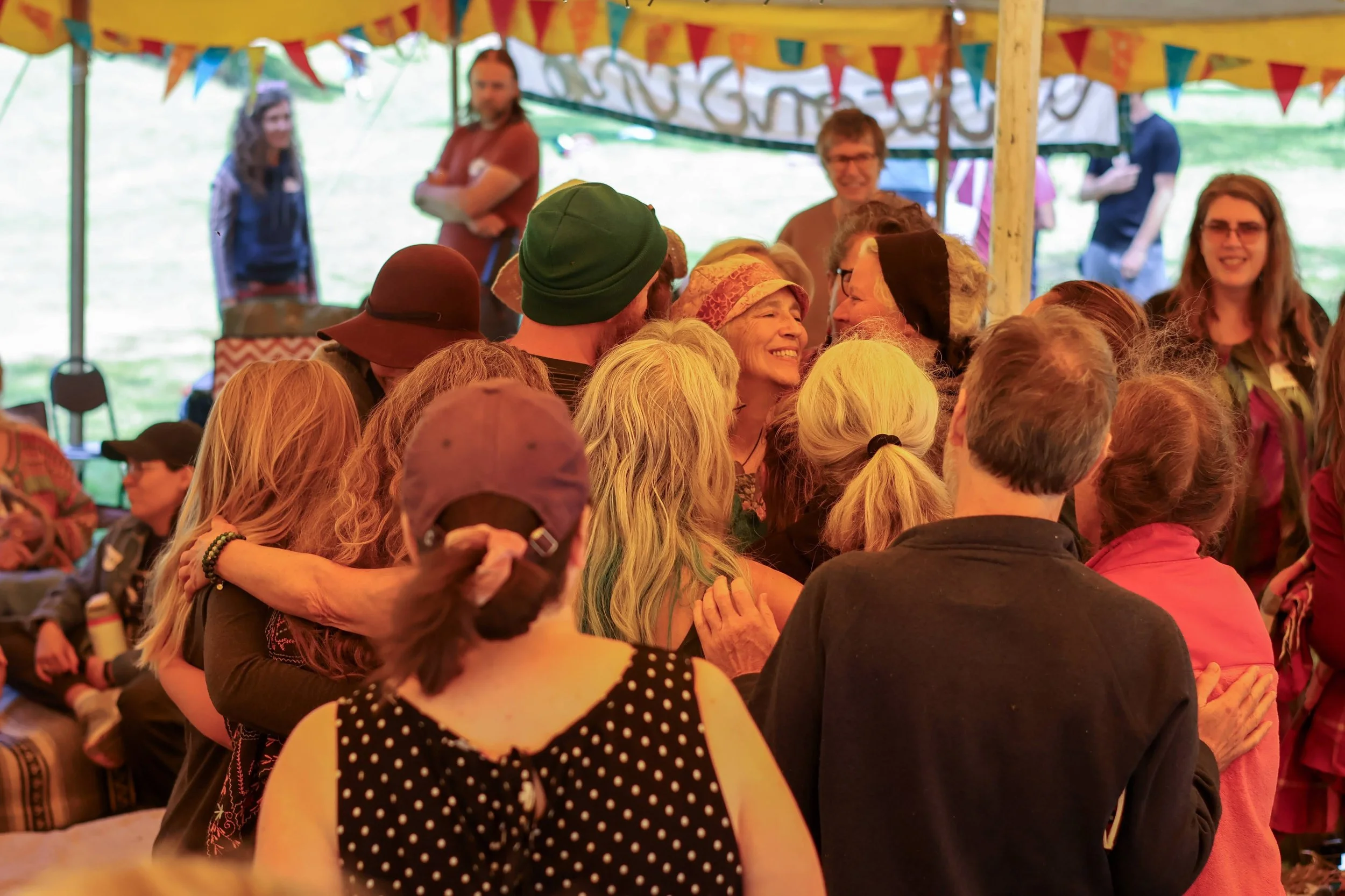
Twenty-two years later, the dream is here and I am part of it. I have found the people who carry the same vision, and we keep finding more of each other. We are feeding the growing movement through the breath we give to songs we sing. Our singing together has made fertile ground where so many of the seeds of a true life-giving culture of belonging can sprout. The songs give us a place to envision our wholeness, to learn to grieve together, to praise nature, to call for justice, to remember how to make things with our own hands, and to play, laugh, move, and be joyful. The songs are leading us where we want to go. They are giving us good work to do, for they cannot live without us. Through singing, we are in reciprocity with life.
It took a long time, but I’ve found my way to be part of the work I most wanted. Along the road there was longing, loneliness, wondering and wandering, experimenting, and failing (aka learning). I see now that all of that mattered. It gave me something that I can give back.
There’s a line in a song by Darrell Scott: “I walk a crooked road to get where I am going, and only when I’m looking back do I see the straight and narrow.”
Somewhere along that crooked road I did become like my dad, director of fun and games, but from my own way of knowing, borne of the questions and needs of these times. And I am generous like him, and I call things good-enough like he did. My mom is in me as I host gatherings, dinners, neighborhood connections; bring physical beauty to spaces; engage in social justice learning and activism, and unceasingly question modernity. (In high school I had been a top student until, with the sudden introduction of calculators and my refusal to buy and use one, I had to drop out of senior physics and trigonometry. My first computer was a gift given to me by my community because they saw before I did that it was not going to be optional in my organizing work; I still don’t have a cell phone, etc. My stubbornness in this regard can sometimes be inconvenient, but I think it’s good for any of us to find some line to hold!)
I see it now: In order to serve my soul’s calling, I needed to put in the time–decades!– and I needed to find my people. And in spite of all of the terrible things that have happened and are happening in our world, I still have hope, for we have songs to sing together and they give us the way to be of service to Life.
Let’s keep going.
The Thing Is
By William Stafford
There’s a thread you follow. It goes among
things that change. But it doesn’t change.
People wonder about what you are pursuing.
You have to explain about the thread.
But it is hard for others to see.
While you hold it you can’t get lost.
Tragedies happen; people get hurt
or die; and you suffer and get old.
Nothing you do can stop time’s unfolding.
You don’t ever let go of the thread..